India's Capital Deepening Problem: When the Official Story Finally Catches Up

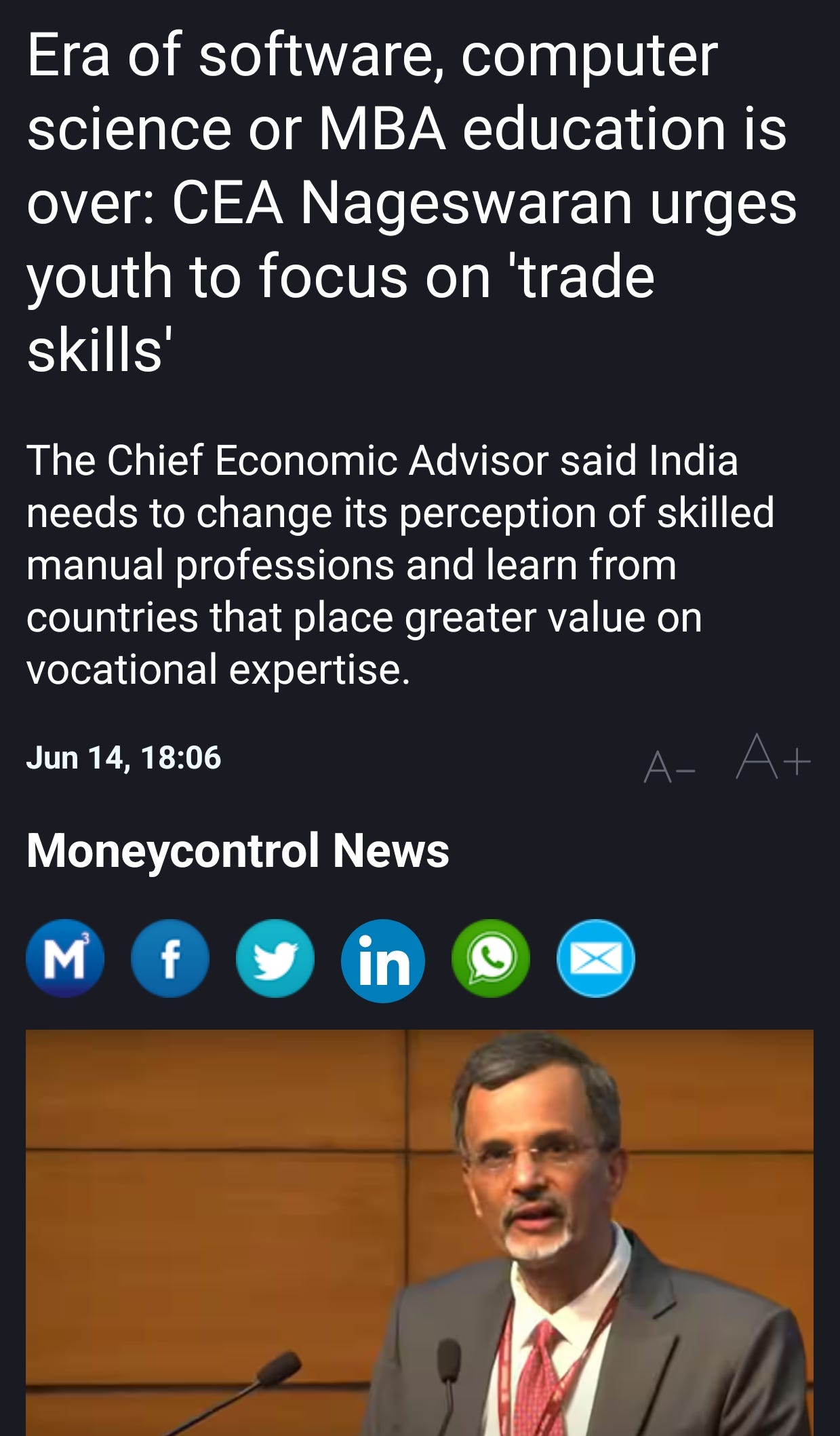
India's Chief Economic Adviser V. Anantha Nageswaran recently issued a striking warning: the era favouring software engineers and MBA graduates is officially over, undone by artificial intelligence. He reframed persistent unemployment not as a demand-side failure but as a structural "livelihood problem," calling for a pivot toward labour-intensive sectors such as caregiving, culinary arts, and vocational trades. The statement made headlines. For those of us who have tracked India's macroeconomic underbelly for years, however, it felt less like a revelation and more like an arrival — belated, cautious, but welcome nonetheless.
The Official Narrative and Its Contradictions
For much of the past decade, the government's position on employment has been one of qualified optimism. Official surveys were redesigned and, as I argued in my analysis "RBI's Houdini Act, (Sep 2024)" changes in survey methodology effectively absorbed disguised unemployment into the formal employment count, flattering the headline figures. When independent economists flagged declining household savings, stagnant real wages, and weakening consumption, the official rebuttal was remarkably sanguine: falling savings rates were recast as a sign of rising income certainty and upward mobility rather than distress (See my piece, Savings fall reflects income crisis, 2023)
Even Nageswaran himself, only a year ago, directed his concern at corporates for underpaying workers, warning that suppressed wages would eventually damage demand. That was an important signal, but it stopped short of diagnosing the structural source of the problem. The official line through 2018 to 2023 consistently asserted robust employment generation — a claim that now sits in uncomfortable tension with the CEA's own current framing of unemployment as a deep livelihood crisis.
What We Have Been Arguing
My macroeconomic assessments over the past several years have centred on a single, stubborn structural reality: India's growth model is deeply skewed toward capital deepening — the progressive substitution of labour with capital — at a pace that the economy's labour absorption capacity cannot match. This is not merely a cyclical problem to be fixed by the next investment cycle or infrastructure budget. It is a structural shift, accelerated by rapid digitisation, corporate automation, and government policies that have disproportionately rewarded supply-side capital incentives.
The macroeconomic consequence has been what I have termed a "data-reality divide": GDP growth looks respectable on paper, but corporate revenue growth, volume demand, and tax collections face persistent headwinds because the purchasing power of the median Indian worker has been quietly eroding. When capital allocation flows predominantly into technology-intensive setups that need fewer workers, the gains concentrate within a thin corporate elite while the broader labour market stagnates. Infrastructure spending — the government's preferred lever — has not triggered the private capital expenditure revival that was promised (see Is the capex Multiplier Overstated, HBL 2025). Instead, it has further tilted the capital-to-labour ratio, producing a "jobless growth" profile across India's expanding industries.
Nageswaran's Belated But Significant Pivot
Nageswaran's latest statements are notable precisely because they acknowledge what the official apparatus resisted for so long. He now concedes that employment elasticity has declined because of capital deepening and technological advancement. He accepts that following the Western capital-intensive manufacturing model will necessarily create industries that "attract less labour or cannot employ more labour." Most strikingly, he concedes that the answer to India's unemployment problem cannot lie in replicating old industrial blueprints — the world has moved on, and so has the technology that shapes production.
His proposed pivot — toward caregiving, culinary arts, vocational trades, elder care, and counselling for special-needs children — broadly mirrors what I and a handful of other independent economists have long advocated (India Urgently Needs a Macro Policy Facelift, NDTV Profit Dec 2022): that India must invest heavily in labour-intensive services and decebtralized industrial proliferation where human presence is structurally irreplaceable. These are the sectors that AI cannot easily colonise, where scale can be achieved through people rather than machines, and where India's demographic dividend can still be honoured rather than wasted.
Where the Gap Still Remains
Acknowledging the problem, however, is not the same as reversing the policies that created it. The capital deepening bias is not accidental; it is baked into India's corporate tax incentives, production-linked incentive schemes, and infrastructure priorities. A genuine pivot toward labour-intensive livelihoods would require not just cultural advocacy for welders and caregivers, but a wholesale reorientation of fiscal and credit policy. There is, as yet, little sign of that harder institutional reckoning in official circles.
The CEA's warning is still a step forward. It narrows the gap between what independent analysts have said and what official India is willing to concede. But the full distance between a belated diagnosis and a corrective policy response remains formidable. India cannot afford to wait another decade for that next step.